Draft
The Variables Inside the Picture
Conversation 2.3 — Hypergraphs and Joint Constraints
The variables inside the picture
In 2.2, the stocks label kept depot,item together inside one SIP vertex. Let us open that vertex to show the variables it constrains together.
Suppose stock also depends on a day. A stocks_on(depot,item,day) tuple says that the depot stocks the item on that day:
eligible_on(driver, job, day) :-
    based_at(driver, depot),
    stocks_on(depot, item, day),
    needs(job, item).
Call these occurrences $D,S,N$, in written order. $S$ now constrains three variables together.
The SIP edges do not change. day occurs only in $S$, so it appears in that atom's label without making a new connection to $D$ or $N$.
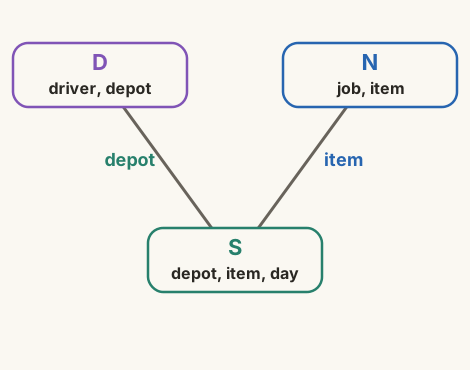
Suppose $D$ and $N$ have already been combined. Their candidate has a driver, depot, job, and item. What does the next stock tuple have to do?
Match its depot and item, then supply a day. The two matches have to succeed in the same stock tuple.
Open $S$ like this: give each of its variables a vertex and put one boundary around them, still labeled $S$. The boundary stands for the atom's joint tuple test.
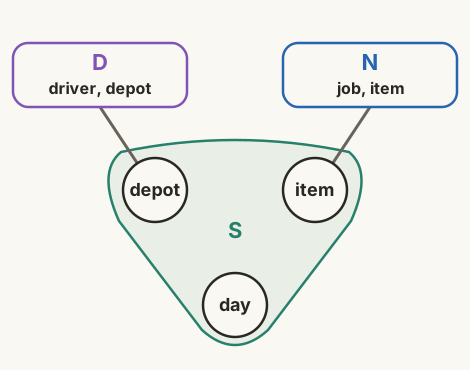
When we open $D$, it will have a depot too. Are we going to draw that variable twice?
Temporarily. The dashed construction guide marks two appearances of the same query variable. We will merge them into one vertex.
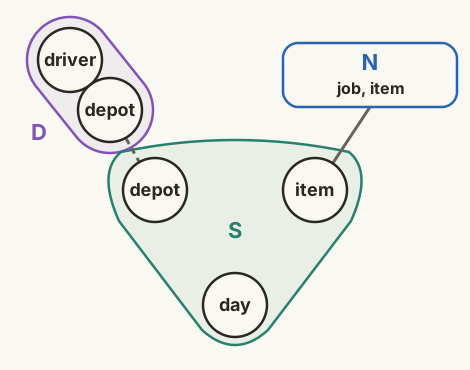
Then both groups will contain that one vertex. Their chosen tuples have to use the same depot value.
Here is the merge. Keep the two atom boundaries: $D$ still tests a driver–depot pair, and $S$ still tests a depot–item–day triple.
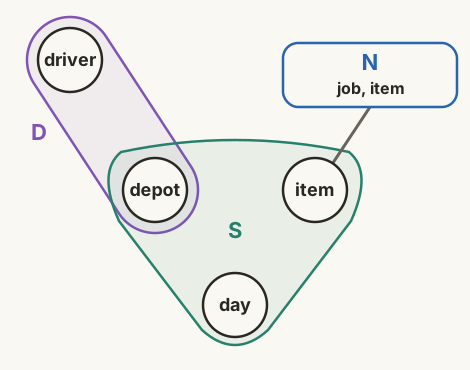
The overlap takes the place of the old depot edge between $D$ and $S$.
I can do $N$ now. Its job is new to this drawing, but its item is already inside $S$.
Here is $N$ opened. Merge the two appearances of item in the same way.
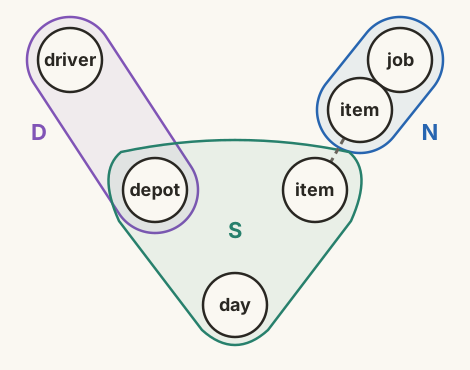
One item vertex, belonging to both $S$ and $N$:
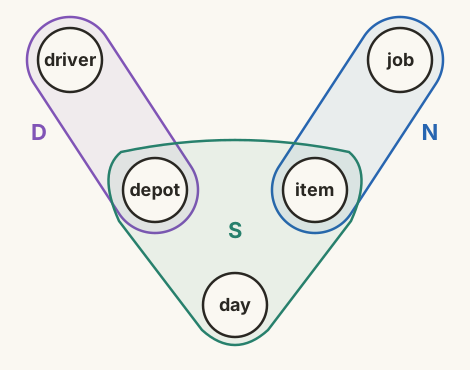
Read our earlier join step from this picture. $D$ and $N$ have been combined, and $S$ is next.
$S$ overlaps $D$ at depot and $N$ at item. It must match both. Only $S$ contains day, which it adds.
I could have worked that out from the SIP labels too.
You could. Opening the atoms makes their variable groups and overlaps visible directly; the SIP labels already contained that information.
Why use a boundary for $S$, though? With three variable vertices, I could draw an ordinary edge between each pair.
What would an edge between depot and day require of their values?
That they occur together in a stock tuple. I would make the same test for depot,item and for item,day.
If all three pairs pass, haven't I checked the three values?
Let us try it. Keep eligible_on unchanged and use these tables. First, what does the original query return?
based_at
| driver | depot |
|---|---|
| Lin | north |
stocks_on
| depot | item | day |
|---|---|---|
| north | bolt | Mon |
| north | nut | Tue |
| south | bolt | Tue |
needs
| job | item |
|---|---|
| job1 | bolt |
Only (Lin,job1,Mon). Lin is at north, and job1 needs bolt. The only stock tuple with both north and bolt has Mon.
So the original query rejects (Lin,job1,Tue). Would your pair checks reject it too? Start with the pair (north,bolt).
That pair occurs in the first stock row. My depot,item check passes.
But that row says Mon. I still have to check Tue.
Look for (north,Tue) in the depot,day columns.
The second row has it—with nut. So this check passes too.
The last check is (bolt,Tue). That is in the third row, with south. All three pass!
Which stock tuple would you use to justify the Tuesday answer?
There isn't one. I used a different tuple for each pair.
Checking every pair did not force the whole triple to be present.
The projections from 1.3 express exactly those separate checks:
Replacing the one stock atom with those three tests gives this query:
eligible_pairs(driver, job, day) :-
    based_at(driver, depot),
    P_di(depot, item),
    P_dt(depot, day),
    P_it(item, day),
needs(job, item).It returns (Lin,job1,Tue): north and bolt satisfy P_di, north and Tue satisfy P_dt, and bolt and Tue satisfy P_it.
My drawing changed what the query accepts. I need one test for the whole stock tuple.
That boundary around depot,item,day represents a hyperedge: a group of vertices that can contain more than an ordinary edge's two endpoints.
Our query hypergraph has one vertex per body variable and one labeled hyperedge per body occurrence, containing all that atom's variables.
The group says these values must pass one test together. The actual stock table says which triples pass.
Can a group have only one variable? We had approved(task) earlier.
Yes. Put it back in its query:
approved_task(person, task) :-
    member(person, team),
    handles(team, task),
    approved(task).
Try drawing all three groups.
member contains person,team, and handles contains team,task. approved has just task:
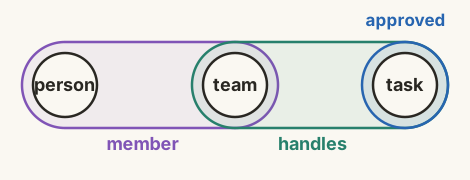
That group can still reject a task.
For a group of exactly two variables, we can use an ordinary line as shorthand. In
one_road(a, b) :- road(a, b).these drawings represent the same atom occurrence $E_1$:
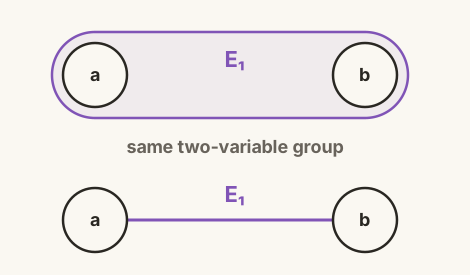
So drawing a line was not itself my mistake. Here the line stands for one binary atom. I tried to replace a three-variable atom with three separate tests.
Your three lines do describe eligible_pairs:
eligible_pairs(driver, job, day) :-
    based_at(driver, depot),
    P_di(depot, item),
    P_dt(depot, day),
    P_it(item, day),
    needs(job, item).
Draw its five body occurrences, keeping $D$ and $N$ in place.
The three projected atoms go between them:
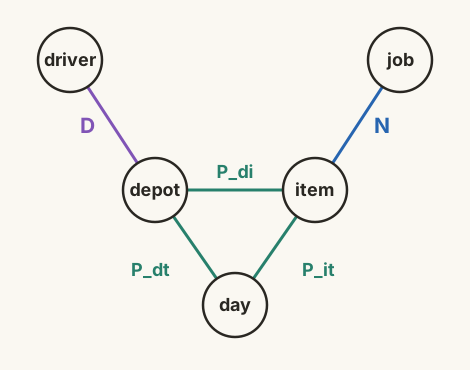
This is where the extra Tuesday answer came from. There is no longer one stock group requiring all three values together.
Those five hyperedges had different variable sets. What if two atoms contain exactly the same variables?
return_trip(a) :-
    road(a, b),
    road(b, a).
Call the occurrences $E_1$ and $E_2$.
Both groups contain exactly a,b, but I still need a road in each direction.
The groups alone will not show which argument comes first.
Suppose road contains only (0,1). Can a=0 be an answer?
The first atom makes b=1. Then the second needs (1,0), which is missing. So no.
If I forgot the second occurrence's argument order, I could count the outward road twice and think I had a return trip.
Here is the query hypergraph. Its vertices are the variables a,b. Each labeled curve represents one two-variable hyperedge, using our line shorthand:
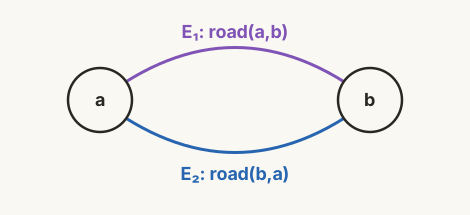
The two groups contain the same vertices. Their atom labels preserve the different tuple tests.
With a=0,b=1, $E_1$ asks for (0,1), while $E_2$ asks for (1,0). The groups coincide, but the tests differ.
The atom label also matters when one occurrence repeats a variable:
self_loop(x) :- road(x, x).How many variable vertices and hyperedges does this query have?
One variable vertex, x, and one singleton hyperedge for the one atom:
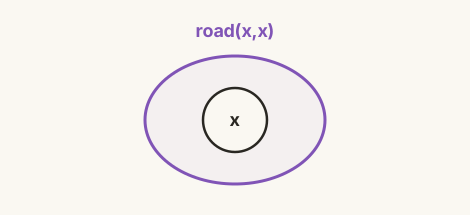
The label road(x,x) still requires equal endpoints. Our stored tuple (0,1) would fail that test.
We have checked how to read individual hyperedges. Now compare how they overlap, starting with our three roads from a common origin:
shared_origin(a, b, c) :-
    road(h, a),
    road(h, b),
    road(h, c).
Bring back the earlier SIP graph, whose vertices are occurrences $E_1,E_2,E_3$ in written order. Open them and merge appearances of the same variable to obtain the query hypergraph.
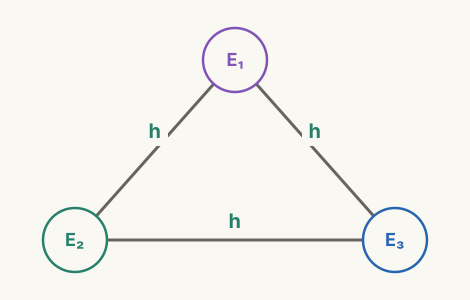
Each opened group contains h. Merging those appearances gives one center:
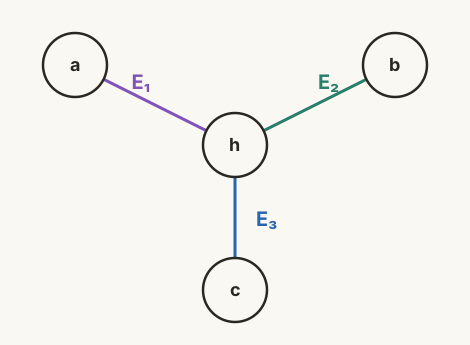
The triangle in the first picture came from every pair sharing that same center variable.
Compare it with this query:
round_trip(a, b, c) :-
    road(a, b),
    road(b, c),
    road(c, a).
Start with its SIP graph, again numbering occurrences in written order.
Every pair shares a variable, so I get another triangle.
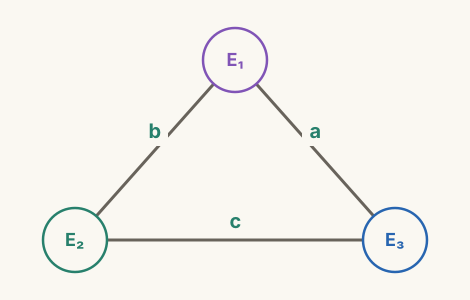
This time the three edges have different labels. I cannot merge all the shared variables into one center.
Apply the same opening rule, merging only appearances of the same variable.
$E_1$ contains a,b, $E_2$ contains b,c, and $E_3$ contains c,a.
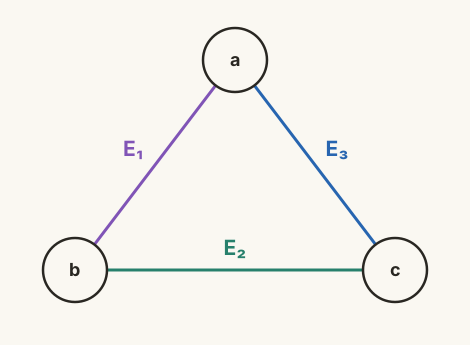
Now the variable picture has a loop too.
Recall the two connections from 2.2. Each road hyperedge keeps its variables together in one tuple test, just as stocks kept depot,item together. Where do you see agreement on a shared variable across atoms?
Where the groups meet. In the star, all three roads must agree on h. In the loop, each pair agrees on a different variable: a, b, or c. There is no common center.
The SIP triangles' labels recorded that distinction. Opening the atoms makes it visible as a star and a loop.
We never looked at the road tuples to draw either one. If road were empty, would this still be the loop-shaped query?
Yes. No tuples would pass, but the query would still impose the same three pair constraints.
Then seeing a loop here does not tell me how many round trips exist. I need the road tuples for that, just as I needed the stock tuples for the five-versus-three counts in 2.1.
The picture still contains every variable. Must the plan keep them all?